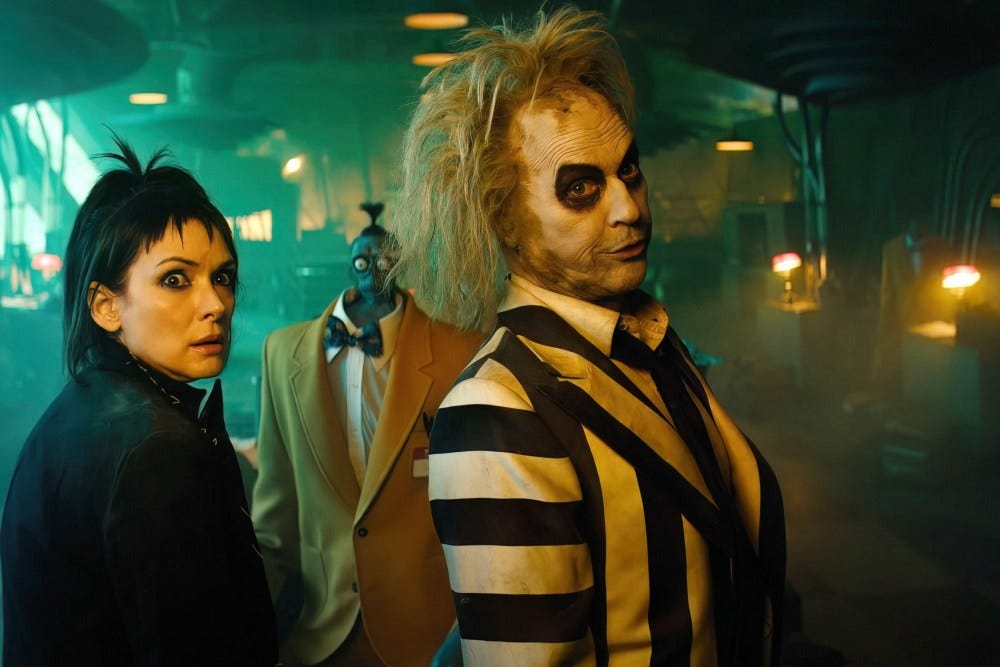
Beetlejuice Beetlejuice is a sequel that understands nostalgia works best when it is allowed to get weird. Tim Burton returns to the handmade eccentricity of the original, even if the new story sometimes feels crowded.
Back to the waiting room.
Burton's world still has texture. Models, costumes and odd little creatures give the afterlife a physical personality that modern fantasy often smooths away.
The Deetz family changes.
Winona Ryder brings Lydia's old melancholy into a new family dynamic, while Jenna Ortega gives Astrid enough distance to avoid simply repeating her mother's story.
The dead have better timing than the living.
Too many doors.
The film introduces several subplots that compete for attention. Some are delightful, but the movie would benefit from staying in one strange room for longer.
A welcome reunion.
Michael Keaton's return is still funny because the character remains an unpredictable force rather than a nostalgia prop.
The practical weirdness is still the reason to come back.
The sequel works whenever the strange details are allowed to be strange for their own sake. The production design is full of little ideas, the dead still have bureaucratic problems, and the comedy has that particular Burton rhythm where a grim image can become funny simply by staying on screen a second too long.